
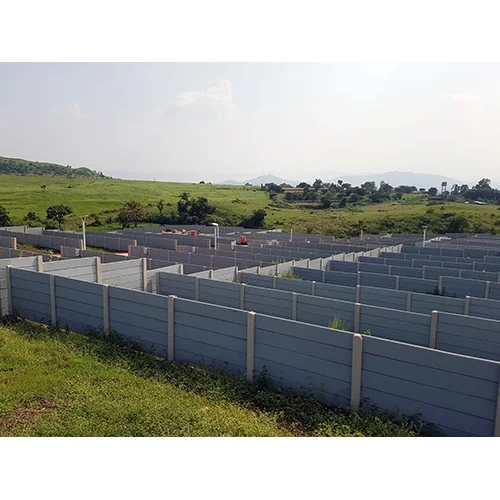


Introduction
In modern construction, innovation blends with efficiency. Among the many breakthroughs redefining how India builds today, the RCC precast boundary wall stands tall — literally and figuratively. Built for robustness, designed for speed, and crafted for sustainability, these modern walls are transforming boundary construction across residential, commercial, and industrial sectors.RCC Precast Boundary Walls
Instead of laying bricks piece by piece under an open sky, precast boundary walls are manufactured in factories with precision molds. Once ready, they’re transported and assembled onsite within days, offering unmatched consistency and strength.RCC Precast Boundary Walls
What Is an RCC Precast Boundary Wall?
RCC stands for Reinforced Cement Concrete, which blends cement, aggregates, water, and steel reinforcement. In the precast method, concrete panels are molded, cured, and strength-tested in a controlled factory setting. These factory-made slabs and columns are then carried to the site and interlocked seamlessly to form a boundary wall.RCC Precast Boundary Walls
The result? A uniform, elegant, and durable wall system built in record time — perfect for homes, institutions, and industrial spaces.RCC Precast Boundary Walls
Why RCC Precast Is a Game-Changer
- Superfast Installation:
Unlike brick masonry walls that may take weeks, an RCC precast wall can be fully installed within 3–7 days depending on the perimeter length.RCC Precast Boundary Walls - Long-Term Cost Savings:
Reduced manpower, minimal site waste, and no curing delays mean up to 40–60% cost savings over time.RCC Precast Boundary Walls - Superior Strength:
Factory-cast panels use M25–M35 grade concrete, giving exceptional tensile and compressive strength compared to traditional walls.RCC Precast Boundary Walls - Sleek Visuals:
Options range from plain cement gray to textured or patterned finishes that mimic brick, stone, or slate.RCC Precast Boundary Walls - Eco-Friendly Construction:
Since these are made off-site, there’s less material waste, less dust, and reduced water usage, making them a sustainable fencing choice.RCC Precast Boundary Walls
Components of a Precast Boundary Wall
Each RCC precast boundary wall consists of several modular elements designed to work as one system:
- Vertical Columns: Reinforced pillars with grooves to support the panels.
- Horizontal Slabs/Panels: Interlocking concrete plates forming the wall body.
- Foundation Base: A small concrete trench to fix the columns securely.
- Optional Accessories: Concertina fencing or paint for additional utility and aesthetics.
Different Types of RCC Precast Boundary Walls
Depending on use and strength requirements, several types of RCC precast boundary walls are available:
- Standard Boundary Wall: Ideal for homes, offices, and societies seeking durability and visual appeal.
- Heavy-Duty Industrial Wall: Designed to resist mechanical impact and heavy loads.
- Folding or Modular Wall: Adjustable, reusable, and perfect for temporary enclosures.
- Hollow-Core Precast Wall: Lighter but sound-dampening and thermally insulating.
- Decorative Designer Panels: Aesthetic options for schools, villas, or commercial use.
Design Specifications
According to top Indian manufacturers, standard dimensions include:
| Component | Dimensions | Concrete Grade | Usage |
|---|---|---|---|
| Panel | 1800×300×50 mm | M25 | Wall surface |
| Column | 7×1×2 ft | M30 | Vertical support |
| Height | 5–10 ft | — | Per design |
| Foundation Depth | 1–1.5 ft | — | Stability |
These modular parts are fabricated to achieve perfect joint fits and aesthetic uniformity once installed.
The Installation Process (Step-by-Step)
The efficiency of RCC precast walls lies in their engineering precision. Here’s how the installation unfolds:
- Site Preparation:
The site boundary is leveled and a narrow trench is excavated. - Foundation and Column Fixing:
RCC columns, each reinforced and precast, are placed at regular intervals using concrete footing. - Panel Insertion:
Precast slabs are slotted vertically into the grooves of the erected columns, fitting snugly without needing mortar. - Alignment and Leveling:
Engineers ensure all panels align horizontally and vertically to maintain wall straightness. - Finishing Touches:
The final step may include anti-corrosive coatings, textured paint, or concertina wire fencing.
This modular construction means an average 100-foot stretch can be installed within two days, depending on manpower and logistics.
Durability and Maintenance
RCC precast boundary walls are essentially “build and forget” structures. Their steel reinforcement prevents cracking or chipping, while the high-strength concrete resists corrosion, moisture, and temperature changes.
RCC Precast vs Brick Wall: Comparative Table
It’s clear that RCC precast technology not only saves time but ensures superior and long-lasting protection.
Design Aesthetics and Modern Finishes
Manufacturers now offer RCC walls in finishes that complement both rural and urban architecture:
- Brick Textured Panels: Mimic red bricks without water seepage issues.
- Polished Surface Panels: Sleek finish ideal for modern homes and offices.
- Stone Texture Panels: Create a rustic, luxurious effect for farmhouses.
- Dual-Tone Painted Walls: Add contrast and sophistication for residential compounds.
These walls can also incorporate branding, gates, or lamp-post extensions, offering design flexibility rarely possible with traditional masonry.
Environmental and Economic Advantages
Opting for precast technology reduces onsite pollution, noise, and raw material wastage. It helps conserve water and promotes recycling of leftover concrete slurry.
From an economic standpoint, their long lifespan eliminates recurring repair costs, while factory mass production brings down unit cost substantially. Builders can complete perimeters faster, translating into quicker project handovers and better ROI.
Applications Across Sectors
Residential Projects: Stylish, low-cost, and secure boundaries for homes and apartments.
Commercial Properties: Professional aesthetics suitable for corporate campuses.
Industrial Parks & Warehouses: Heavy-duty setups ensuring perimeter safety.
Agricultural Lands & Farms: Easy to install and relocate as ownership boundaries shift.
Government & Institutional Premises: Used for high-security perimeters and noise control.
RCC Precast Walls with Fencing
Many builders now enhance walls with G.I. concertina coil fencing for added protection. These are especially common in high-risk or large properties. Combined with M35-grade RCC panels, they create tamper-resistant barriers that meet industrial safety codes.
The Future of RCC Precast Construction
As infrastructure expands across Indian cities, precast technology promises speed, scalability, and sustainability. Already, tier-1 and tier-2 cities are adopting it for apartments, logistic hubs, and schools. With automation, robotic mixing, and smart molds, the Indian precast wall industry is projected to grow by 12–15% annually by 2030.
Innovations like hollow-core insulation walls and modular extensions for solar fencing will continue shaping its growth. The focus is shifting from mere construction to smart, reusable, and energy-efficient walls.
Keywords Optimized for SEO:
- RCC precast boundary wall price
- Precast compound wall installation
- Best precast boundary wall manufacturers in India
- Prefabricated boundary wall cost per sqft
- Concrete boundary wall design ideas
Conclusion
The RCC precast boundary wall isn’t just another construction trend — it’s a smarter, greener, faster way to build. With modular flexibility, high strength, and visually appealing finishes, it has rightfully earned its place in modern architecture.
If you’re planning to fence your plot, create a protective boundary, or design a sustainable real estate project, precast RCC walls offer the perfect balance of efficiency, economy, and elegance.
Understanding RCC Precast Boundary Walls
If you’ve ever walked past a sleek, sturdy wall enclosing a modern property and wondered why it looked so perfect, there’s a good chance it was an RCC precast boundary wall. These walls have become the go-to choice for property developers, homeowners, and industrial builders for one simple reason — they combine strength, beauty, and speed like no other wall type.
At its core, an RCC (Reinforced Cement Concrete) precast boundary wall is made of concrete enhanced with steel reinforcement. What makes it unique is that the wall panels are molded and cured in a factory, ensuring accuracy, quality, and uniformity. After that, these panels are transported to the construction site and assembled using vertical concrete columns.
The Origin of Precast Wall Systems
The concept of precast walls actually goes back decades, used initially in Europe and Japan for quick infrastructure development. In India, the RCC precast boundary wall trend began gaining momentum in the last decade, primarily because of urban construction needs. Builders realized that time, space, and cost efficiency were just as important as strength and aesthetics.
Today, precast concrete walls are seen not only in housing projects but also around industrial zones, warehouses, farms, and even educational or government complexes.
Core Features of RCC Precast Walls
An RCC precast boundary wall is engineered for performance. Each part of it is designed to fulfill a specific role:
- Concrete panels: These are the horizontal slabs that form the body of the wall.
- Columns: Vertical supports designed with slots to hold the panels firmly.
- Base foundation: Provides stability, ensuring the wall stands secure even on uneven ground.
The typical wall height can range between 6 to 10 feet, and the columns are reinforced with M25 grade or higher concrete, depending on site requirements. Builders can even choose textures and finishes like plain, patterned, or stone-style surfaces.
Benefits that Make It Stand Out
The strongest point of precast walls is their hybrid benefit set — they’re both practical and beautiful. Here’s what sets them apart:
- Speedy Installation:
Since panels are precast off-site, assembling them takes only a few days compared to brick walls that require weeks. - Durability and Strength:
Reinforced with steel and dense concrete, these walls withstand harsh sunlight, rainfall, or even physical impact, lasting for decades. - Cost Efficiency:
Reduced labor and material waste make the overall cost lower than brick-masonry walls by up to 50–60% in some projects. - Design Flexibility:
Think modern, patterned, or simple industrial-grade finishes — precast walls can match any architectural style. - Eco-Friendly Construction:
The entire process occurs in a controlled environment, reducing dust, noise, and water usage, thus supporting green construction practices. - Low Maintenance:
No cracking, no re-plastering — just an occasional wash or coat if you want a new look.
Types of Precast Boundary Walls
Developers and homeowners can select from a variety of precast RCC wall styles depending on function and budget.
- Standard Precast Boundary Wall – Ideal for residential use where strength and appearance are priorities.
- Heavy-Duty Precast Wall – Designed for factories or transport yards where impact resistance is key.
- Hollow-Core Wall – Lightweight and insulating, these help maintain temperature and save energy.
- One-Piece Casting Wall – Made as a single slab without joints, offering high security for sensitive areas like data centers or defense properties.
- Folding or Modular Wall Systems – Designed for easy relocation or temporary fencing needs.
The Construction Process – Step by Step
Although RCC precast walls appear complex, they follow a straightforward and efficient process:
- Design and Planning:
Engineers create a design based on the property dimensions and required height. - Panel Casting:
Panels are poured into reusable steel molds, vibrated to remove air gaps, and then cured to reach the desired strength. - Column Fabrication:
Columns with steel reinforcements and grooves (for panels) are precast alongside. - Transportation to Site:
Once the elements are cured, they’re carefully transported to the installation site. - Foundation Setup:
A shallow foundation is prepared, aligning the footing where the columns will be placed. - Assembly:
Columns are fixed into the base, and wall panels are slotted in between — like assembling Lego blocks. - Inspection:
A final check ensures alignment, level, and firmness. Once approved, the wall is good to go.
This entire process can be completed in a few days, depending on the size of the plot and workforce.
Unique Design Options
Gone are the days when concrete meant dull and grey. Modern RCC precast boundary walls come with striking finish options, such as:
- Exposed aggregate finish for a natural stone look
- Smooth matte surfaces for contemporary projects
- Patterned or embossed textures for decorative fencing
- Dual-tone paint combinations for aesthetic appeal
Custom designs even allow company branding or logos to be embedded — perfect for industrial parks or school boundaries.
Real-World Applications
- Residential Compounds:
Adds both security and curb appeal. Many gated communities now opt for these walls for visual uniformity. - Industrial Premises:
Heavy-duty RCC walls are preferred for protecting machinery and materials. - Schools and Institutions:
Clean and safe enclosures that last decades with almost zero maintenance. - Agricultural and Farm Lands:
Quick fencing to keep property protected and livestock safe. - Public Infrastructure Projects:
Used as noise barriers, roadside barricades, and retaining walls for slopes.
Durability and Weather Resistance
Precast RCC walls score high on endurance. The combination of high-tensile steel and dense concrete allows these walls to endure thermal expansion, corrosion, and seismic activity. Even under moisture exposure, hairline cracks are minimal.
The material’s fire resistance makes it safer than wooden or metallic alternatives. In sound-sensitive zones, its mass effectively blocks out noise, offering privacy as well as peace.
Economic and Environmental Impacts
From a builder’s standpoint, the economics of precast technology make perfect sense. Labor costs drop dramatically since on-site mixing, curing, and scaffolding become unnecessary. Factories achieve mass production efficiency, meaning large-scale orders can be fulfilled quickly.
On the green side, this system saves water, limits waste, and allows recycling of leftover materials like cement and aggregates. The reduced dust emissions during installation align perfectly with modern eco-construction standards.
Regional Manufacturing and Customization
Several leading firms across India, including Triranga Infra Projects Pvt. Ltd. and Shri Chamunda Tarbandi (Rajasthan), produce top-quality precast boundary walls with customized finishes and reinforced column systems.
They employ automated batching, vibration compaction, and precision molding, resulting in panels that are dimensionally perfect. Manufacturers also offer modular packages for houses, factories, and even gardens, allowing easy expansion or relocation later.
Comparing Brick Walls and RCC Precast Walls
The Future of Boundary Construction
As India’s cities expand and real estate turns vertical, efficient boundary solutions like RCC precast walls are becoming the industry norm. Architects favor them for design consistency, contractors love the time savings, and owners appreciate the low maintenance cost.
Many big projects now specify precast boundary systems in their architecture guidelines because they promote sustainability, aesthetics, and long-term resilience.
Expert Insight: One-Piece and Hollow-Core Innovation
The newest trends in the market include one-piece casting walls and hollow-core walls — innovations that enhance both structural integrity and insulation.
A one-piece casting eliminates joints, making it ideal for areas requiring high security. On the other hand, hollow-core precast walls use air cavities to reduce mass and improve heat insulation.
These advances mark a shift from just functional fencing toward multifunctional, design-driven perimeter systems.
Conclusion
When you look at all the benefits — speed, cost-effectiveness, customizable designs, and sustainability — it’s easy to see why RCC precast boundary walls are redefining modern construction in India. Whether for homes, farms, or massive industrial projects, they deliver unmatched durability with a touch of aesthetic finesse.
If you’re planning your next compound or fencing project, it might be time to leave bricks behind and go precast. It’s not just a wall — it’s a smarter, stronger, and more sustainable way to build.
The imformation is from www.perplexity.ai,ckdenterprises.com,wikipedia.

hello brother’s and sister